Edinburgh to Bathgate Circular Route

Route out – Edinburgh (South Lauder Road to The Meadows to Slateford to Wester Hailes) to Ratho to Broxburn to Winchburgh to Linlithgow to Beecraigs Country Park to Cairnpapple Hill to Bathgate. For route map click here.

Route back – Bathgate to Livingston Village to Mid Calder to East Calder to Kirknewton to Balerno to Currie to Juniper Green to Edinburgh (Slateford to The Meadows to South Lauder Road). For route map click here. Google Maps is wrong for some of the section through Livingston. Just stay on Route 75 all the way and you won’t get lost.

  • Weather – Light rain at first, then mainly cloudy with some sunny intervals and no wind. Quite cold too.
  • Distance travelled – 56.35 miles
  • Riding time – 6 hours 51 minutes
  • Maximum speed – 33.1 mph
  • Average speed – 8.2 mph

The weather here has been very cold for weeks so Dad and I hadn’t been out cycling for ages. Luckily, on Saturday it looked like it would actually be a fine day to go for a cycle – still cold but at least it wasn’t frosty for once… Dad wanted to head south (as usual) for a route around the Scottish Borders but I decided that we would investigate two of the really good cycle routes nearer to home which start in Edinburgh: National Cycle Routes 754 and 75.

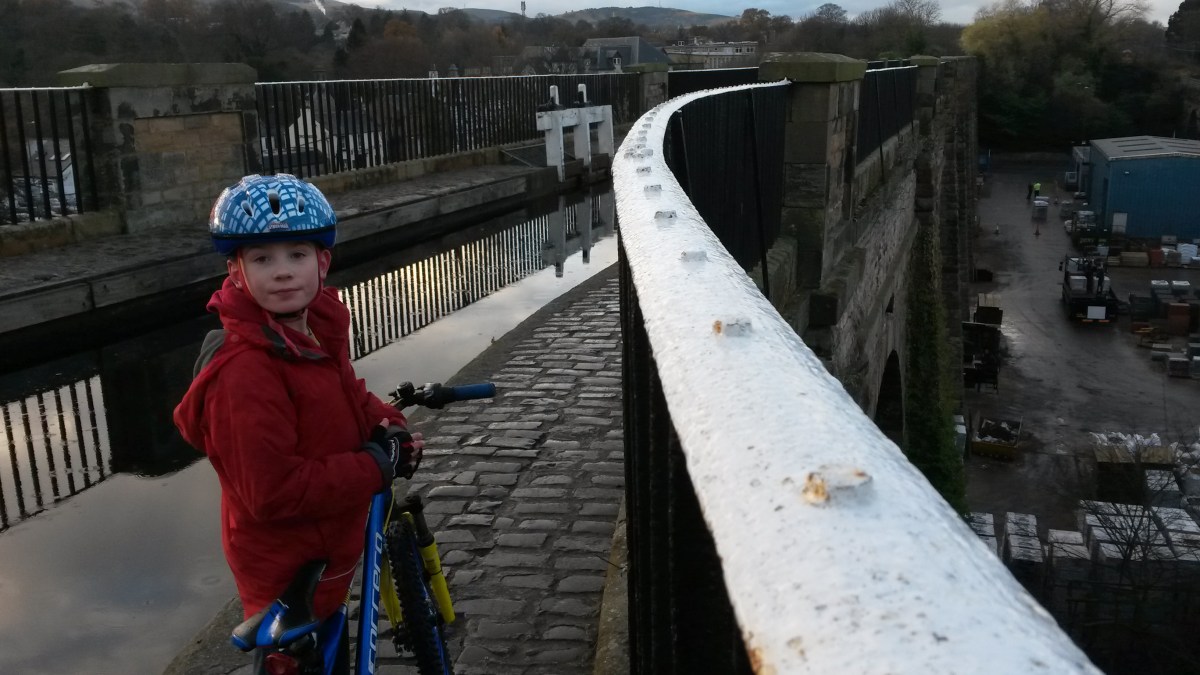
We parked the car in The Grange which one of the poshest areas in Edinburgh where all the houses appear to be mansions. Not much like Gorebridge then… Here we followed one of the signposted “quiet routes” (no.6) to The Meadows where we joined onto Route 75. After a short section along the cycle path through the park, we followed the route 75 signs onto the road for half a mile or so before turning off onto the Union Canal at Fountainbridge. The path alongside the canal soon becomes route 754, is completely flat and takes you all the way to Glasgow without going on any roads at all. We weren’t going that far today though – our first main destination of the day was Linlithgow, 22 miles away. The quality of the canal path varies a lot along the way. In Edinburgh it is quite a nice surface but is quite busy with pedestrians and dogs so you need to be very careful not to fall in the water or crash into anyone. Outside the city it is often very narrow, muddy, bumpy or squelchy with leaves so I found it a bit of a monotonous plod at times and it was a lot slower than I’d thought it would be. Because you are low down and never go up any hills, the views are not all that good either but there are some interesting bits, especially the amazing aqueducts which carry the canal high up over roads or rivers: the Slateford Aqueduct, the Scott Russell Aqueduct which crosses over the City Bypass and the Almond Aqueduct are all very impressive and it’s worth cycling along this route just to see these. Note that you have to push your bike along the aqueducts as the path is extremely narrow and made of cobbles and you really don’t want to fall into the water… The canal passes through some towns and villages along the way including Ratho, Broxburn and Winchburgh. Eventually, after the bumpiest section of the canal path, we finally reached Linlithgow.

In Linlithgow, I was glad to get off the path and onto a proper road again and we cycled past the train station and into the town centre where Dad said he knew of a really good bakers where we could get some lunch. We ate our (very tasty) macaroni pies beside Linlithgow Loch where we got a good view of Linlithgow Palace. We also had to fend off a flock of pesky seagulls who were trying to steal our food! After that we turned onto the minor road to Bathgate and this turned out to be one of the hardest few miles of cycling I’ve ever done. This road heads south from the town and goes incredibly steeply uphill. We climbed about 350m in only 2 or 3 miles I think as the road winds its way through Beecraigs Country Park. Beware though: this may be an unclassified road (so not even a B road) but it was unexpectedly busy with traffic. This is particularly an issue when you are toiling up roughly a 10% gradient slope at only 3 or 4 mph… However, this was more than made up for with the good views back down towards the Forth where I spied a railway viaduct in the distance. Near the top we turned off onto an even more minor (and thankfully quieter) road which climbed up even further as we cycled past Cairnpapple Hill. From here we had an amazing view back down towards the 3 Forth Bridges and could even see North Berwick Law far far away in the distance. After that came the most fun section as we sped back down the other side of the hill (14% gradient at one point according to the sign) to the town of Bathgate.

In Bathgate we managed to find the signpost for Route 75 next to a supermarket so followed it onto a nice smooth cycle path. The path is nice and wide and mostly flat with some slight ups and down to keep it interesting and fairly fast. It was also very quiet and a pleasure to cycle on. We passed some weird pyramid things and crossed over the M8 motorway before travelling through some woodland that reminded me of Gore Glen near our house. After a while we came to an unexpectedly nice part of the town of Livingston – Livingston Village – not at all like the ring roads, roundabouts and housing schemes of rest of the town. Then the path followed the River Almond, past the football stadium and then headed through the woods to Mid Calder. This is a lovely part of the route and I’ll be coming back here again. Unfortunately, it was around here that Dad got a puncture on his back tyre so we had to waste quite a long time while he changed the inner tube. Dad always carries plenty spare tubes and tools in his bag when we go cycling just in case. It’s actually quite amazing that after over 1000 miles, this is the first time either of us have had a flat tyre. By this time, the light was starting to fade (too dark for photos anyway!) and we still had a quite a long way to go. So we sped as fast as we could through East Calder and Kirknewton (crossing over the level crossing at the train station was the best bit) before heading onto the quiet back road for a few miles to Balerno, near the Pentland Hills on the outskirts of Edinburgh.

By the time we got there, it really was pretty dark and it was clear that our bike lights, though they may have been useful in helping traffic see us, weren’t exactly doing much to help us see as we cycled. Our intended route from Balerno was to follow Route 75 along the Water of Leith until it joined back onto the Union Canal but the cycle path was just far too dark and wouldn’t have been safe. Dad made the decision that we would stick to roads with streetlights and we basically just cycled along the pavement alongside the main A70 road through Currie and Juniper Green for about 8 miles all the way back to the Meadows (passing the Slateford Aqueduct on the way). I’m sure the Water of Leith path would have been much nicer but I’ll have to come back during daylight hours to find out. Although I couldn’t predict that Dad would get a puncture or that the Union Canal route would be so slow, I did learn an important lesson today. In winter when there are less hours of daylight, it would be more sensible to stick to slightly shorter routes rather than ending up having to cycle for an hour in the dark. Still, it was nice to be out on my bike again after such a long break and we even had seafood pizza for tea when we got home!

Hawick to Saughtree (mostly) Circular Route

Route out – Hawick to Stobs Castle to Bonchester Bridge to Saughtree. For route map click here.

Route back – Saughtree to Steel Road to Whitrope Heritage Centre to Stobs Castle to Hawick. For route map click here.

  • Weather – Mainly cloudy and cool with some sunny intervals and an annoying northerly wind on the way back.
  • Distance travelled – 42.99 miles
  • Riding time – 4 hours 25 minutes
  • Maximum speed – 34.1 mph
  • Average speed – 9.7 mph

It’s not every day that you see cows on the road next to a cattle grid or some old trains completely in the middle of nowhere, but last wednesday Dad and I saw both…

I have been enjoying cycling in the Scottish Borders recently so I decided that we would go on a long route through the hills to the south of Hawick, one of the main towns in the Borders. We headed south out of the town along the B6399. This is a lovely quiet road that basically follows a small river and is mostly flat for the first 4 miles or so. After apparently passing Stobs Castle (which we couldn’t see from the road) there was a steep uphill section which gave good views of the countryside looking back down to where we’d come from. At the top of the climb we turned left onto the single track road signposted for Bonchester Bridge. This road climbed relatively gradually until we reached a height of well over 300m and was deserted apart apart from a herd of cows that we met at the top of the hill. We had to wait till they cleared the road before we could cross over the cattle grid. After that it was very fast down the other side with amazing views as far as the Eildon Hills near Melrose in one direction and (probably) England in the other. The single track road eventually joined onto the A6088 for the last mile to Bonchester Bridge. This was a really fun short section despite being a main road. There was almost no traffic at all and it was all downhill so we speeded there in no time at all.

There isn’t much to see in Bonchester Bridge (apart from a bridge) so we carried on out of the village on another very quiet, narrow road (passing an odd looking church at Hobkirk along the way) before climbing up an incredibly steep (but short) section which took us up to the B6357 road which is another quiet road with a good surface for cycling on. We had cycled on another part of this road before when we’d visited Rowanburn a couple of weeks ago but this section of the road was much more challenging. Soon the road began to climb very steeply uphill – probably at least a 10% gradient, though there were no signs. It seemed to go uphill for a long time but it was actually only a few miles really. At the top of the hill we got a nice view over to the Kielder Forrest in the distance and I even found some brambles to munch on to give me an energy boost. It was really hard cycling to the top (over 350m high) but it was worth it because it meant we got to speed back down the other side of hill as fast as we could all the way to Saughtree a few miles away.

Here, we passed the turning for Kielder that we cycled on before but we ignored the signs and continued along the almost traffic-free B6357 for a few more miles of lovely smooth, flat cycling through the Borders, following the Liddel water until we spotted a Cycling Byway signpost pointing to the right. We went this way onto a very narrow road that took us through some really peaceful, pleasant countryside for a few miles, passing under an old (dismantled) railway bridge at a tiny hamlet called Steel Road before eventually joining up with the B6399 once again. At this point we turned right to begin the journey back to Hawick. Unfortunately though, the wind had decided to increase and for the last 15 miles of the route we would be cycling straight into the wind. To make things even worse, the next section was all uphill for a long time…

Actually, it wasn’t all that bad as the road was quiet and the sun came out for a while so we just plodded along slowly until we reached the top of the hill (well over 300m again!). I bet it is a lot more fun going in the other direction though. Anyway, just before the top of the hill, we went underneath another old railway bridge but this time, on the other side we got a really unexpected surprise to see a line of old railway engines and carriages right on the roadside, completely in the middle of nowhere. I love trains so this was easily the highlight of the day. It turns out that this was the Whitrope Heritage Centre and this section of old track was once part of the old Borders Railway (Waverley Line). The centre was closed for the year but we did stop long enough to get some nice photos and we sat on an old section of track to have a snack. Not far north from here on the road back to Hawick, we spotted a lovely old railway viaduct as well. I really hope that the new Borders Railway is extended to run through this part of the country again all the way to Carlisle as it really is very scenic and it would be a very nice train ride. Shortly after the viaduct we passed the turning for Bonchester Bridge once more and then headed back down the hill, before having an easy cycle for the last few miles back to Hawick. According to Google Maps, we climbed over 2600 feet today and it really felt like it as there were a lot of hard uphill sections on this route. But if you don’t mind the steep hills, and fancy a day out in some very quiet and (at times) very interesting countryside, then this is the route for you.

Grand Tour of the Scotland-England Border

Route out – Rowanburn to Kershope Bridge to Newcastleton Forest to Kielder Forest to Kielder Water to Kielder. For route map click here.

Route back – Kielder to Newcastleton to Rowanburn. For route map click here.

  • Weather – mostly sunny and relatively warm with a light breeze but one long rain shower later in the day.
  • Distance travelled – 49.91 miles
  • Riding time – 5 hours 3 minutes
  • Maximum speed – 31.9 mph
  • Average speed – 9.8 mph

On the way home from our holiday in Wales in July, we had stopped for a rest in the lovely (and brilliantly named) village of Rowanburn in Dumfries and Galloway, not far from the border between Scotland and England. I had noticed that the roads near Rowanburn looked perfect for cycling so I’d been thinking of going there for a cycle for ages. Finally, last Saturday, Dad and I managed to go back there with our bikes to have a grand tour of the Scotland-England border.

We headed north out of Rowanburn along the B6357. This is lovely smooth road for cycling on and not too busy with traffic. After less than a mile we entered the Scottish Borders and had to cycle up a short but steep 11% gradient section of road so that fairly warmed our legs up. Soon after, we turned right onto the B6318 which immediately took us steeply downhill to a bridge over the Liddel Water and back up another extremely steep hill into Cumbria. We were in England for the first time today! Around here, the Liddel Water marks where the Scotland-England border is for quite a long distance and our route basically followed this in a north-east direction along very quiet, scenic and narrow roads for about 5 miles until we almost reached a place called Kershopefoot. Here, the border changes direction, heading more towards the east along a different river called the Kershope Burn. At a junction, we headed right and then over the border river and up a very steep section, back into the Scottish Borders. The road goes relatively high up here and the views are really nice. Soon we doubled back on ourselves at an acute angle and headed back down the hill to England again at Kershope Bridge. We stopped here to have an early lunch among the sheep to give us an energy boost before tackling the hardest part of the route.

At Kershope Bridge we turned left and followed the signs for National Cycle Route no.10 which took us into the forest on a reasonably smooth landrover track. After a short while the track crossed over a bridge across the burn back into the Newcastleton Forest in Scotland. After this the path followed the border burn for a long time and the path seemed to become bumpier and bumpier along the way. It was also all uphill and really hard going at times and I almost thought about turning back. Luckily I spied some wild blueberries growing at the edge of the fir trees so I stopped to fill my face and I cheered up a bit after that. Eventually, we reached another bridge and this took us over the border again to England and the Kielder Forest in Northumberland. This was the worst section of all as the path became un-ridable due to the loose stones and the steepness of it, even on a mountain bike. After pushing up the slope to the highest point, the path leveled out but the loose stones made it very unpleasant to ride along. I really was wondering why Sustrans had made this a signposted cycle route. It must have been someone’s idea of a joke surely… It would have made a nice walk though. Thankfully, the bumpy loose stoney path ended when it joined onto another forest road. This was a really nice smooth track and was all downhill so we sped the last few miles to the Kielder Water in no time at all. After about 15 miles of deserted forest, we were finally back in civilisation and saw people for the first time in over 2 hours…

We stopped at the reservoir for a much needed break and a snack of oatcakes. Then we headed onto lovely smooth road once again and sped off northwards in the direction of Kielder. This road is unclassified but on this section it was more like an A road, nice and wide with a white line down the middle and a nice surface for cycling on. Not too much traffic either so that was good. Dad spotted a sign post pointing to an interestingly named place called Gowan Burn and we thought about taking a detour to see what was there. But Dad didn’t think we’d have time for that as we still had about 25 miles to go and we wanted to be back at the car by tea time. So, at Kielder village we just stopped at the shop for Smarties (me) and Yorkie (Dad) before heading in the direction of Scotland once more. The road had by now reverted to single track with passing places and the weather had reverted to rain. Despite the weather, we stopped at the border to photograph all the amazing signs.

The last 20 miles or so of the route was along the B6357 again, heading roughly south and following the Liddel Water once more. It was also almost all downhill and very fast through the quiet countryside along the nice smooth road surface. We stopped in the pleasant little village of Newcastleton to have our last proper break of the day before following the river (which turned into the Scotland-England border once again) back to Rowanburn. It was a long and tiring day but we had crossed the border a total of six times and I really enjoyed most of the route. The roads are very good quality, quite quiet and the scenery is nice so I would highly recommend cycling in this area. Apart from cycle route no.10 through the forest that is – that is NOT recommended at all!

Grand Tour of the Scottish Borders vol.2

Route Out – Innerleithen to Traquair to St Mary’s Loch to Megget Reservoir to Talla Reservoir to Tweedsmuir. For route map click here.

Route Back – Tweedsmuir to Stobo to Lyne Station to Pebbles to Cardona to Innerleithen. For route maps click here and here. Note that there is a bridge over the River Tweed just after Lyne Station that Google Maps doesn’t know about which is why the route back is spilt into two maps. Just follow the Borders Loop signs and you won’t get lost…

  • Weather – cold and misty at first but sunny and warm for most of the day apart from one light shower in the afternoon.
  • Distance travelled – 54.43 miles
  • Riding time – 5 hours 27 minutes
  • Maximum speed – 28.4 mph
  • Average speed – 9.9 mph

On Saturday, Dad and I decided to go on another grand tour of the Scottish Borders. It was very cold when we left the house and as we drove along the road through the Moorfoot Hills the temperature dropped to 1 degrees C. It had only risen by a couple of degrees by the time we arrived in Innerleithen where we would begin the tour, so it was lucky we had brought our gloves…

We headed out of Innerleithen through the freezing mist along the B709. This is very quiet, scenic and in places narrow road, and after passing the village of Traquair, the weather brightened up and the road climbed gradually uphill for what seemed like an age through the hills. Someone has helpfully painted some funny messages on the road along the way. Just as the steepest section begins it says “and up”, and just when you think you’ve had enough it tells you it is “a wee bit further”. Eventually the good news arrived at the top of the climb with the message “and down” along with a smilie face. From there, there was a few fast and fun miles of downhill cycling until the junction with the A708. Here we turned right onto the main road which seemed quite quiet for an “A” road. After a few miles of fairly flat road, we came to the head of St Mary’s Loch. There was a thick fog hanging around over the loch and the water was so still that it was almost like a mirror. The reflection of the hills on the water surface was amazing.

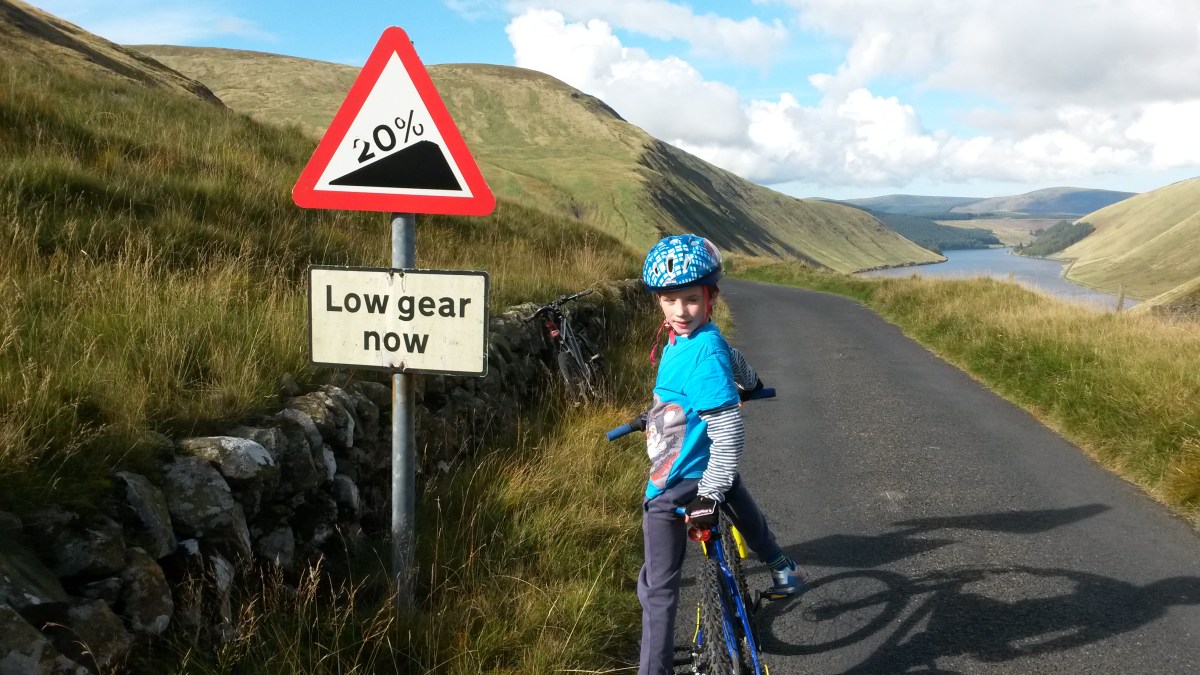
Leaving the loch behind, we turned right onto the single track road to Tweedsmuir. Dad had driven along this road before and warned me that it would be very hilly in places – and he was right. It was a really fun road to cycle on though and one of the most scenic too as it goes right through some of the highest of the Border hills. This section was virtually traffic free (apart from a police car and a quad bike) but at one point we were almost driven off the road by a flock of sheep. One of the steepest climbs takes you past Megget Reservoir. We stopped here for a chocolate digestive or 2 (well I had 1 and Dad had 2) and we were overtaken by a large group of cyclists who seemed to be taking part in some sort of race. They were going much faster than us certainly. Apparently this reservoir provides drinking water to the city of Edinburgh (at least that’s what the information sign said). The road follows the reservoir for a few miles going up and down all the time. Eventually, after passing by 2 half eaten hedgehogs and a guilty looking buzzard, we stopped at the far end of the reservoir and for an early lunch. The road then went steeply uphill for a while until, finally, we reached the highest point of the road at about 450m high according to the map. From there the view down through the hills to the Talla reservoir was stunning and the road down to it was incredibly steep – the sign said it was a 20% gradient so I was glad were going down and not up this hill. Strangely, the group of cyclists we saw earlier were racing back up this steep hill as fast as they could. It must have been torture. We left them to it and sped the other way as slowly as possible (15mph with brakes fully on!) in order to avoid crashing and were soon cycling on the flat road alongside the Talla reservoir with impressive mountains on both sides. At the far end of the reservoir we saw a deer jump in and start swimming for the other side. Dad said he didn’t know deer could swim. Maybe they can’t. Hopefully it made it across OK… Then it was only a short downhill stretch to the village of Tweedsmuir where we had a rest (and another digestive) before tackling the next section of the grand tour.

We turned right after Tweedsmuir onto the main A701 road. This is a very scenic road to cycle on. The only problem is that it’s a main road, and although it’s the signposted “Borders Loop” cycle route and is not too busy for an “A” road, it seems to be popular with motor bikes too and we got over-taken loads of times, making it not too pleasant really. Because of all the hills everywhere, there are no other possible roads to take so we had no option but to go this way or back up over the 20% climb … so the A701 won. Annoyingly, there’s a dismantled railway line which basically follows the road all the way. If only someone would turn this into a cycle path, then we could have avoided the main road altogether… Anyway, after about 7 miles we were glad to turn off onto the B712 which is one of the back road to Peebles. To make the route more interesting we soon detoured left off this road onto a single track road which climbed high up and gave great views of the countryside and the hills of the Tweed valley. It was along this road, after 34 miles of cycling, that we finally found our first brambles of the day. So we stopped to stuff our faces of course. Then, after a fast downhill section, we rejoined the B712 and cycled past Stobo Castle. Strangely enough, the B712 was even busier with traffic than the A701 and was not much fun at all despite the good views. It was quite a relief to turn off onto the narrow road for Lyne Station.

There used to be a railway station at Lyne Station back when there were steam trains running, and here we followed the Borders Loop signs again and went under the bridge of the dismantled railway line (which is a signposted walk to Peebles), then over a narrow bridge across the River Tweed (the one Google Maps doesn’t know about). After a short muddy, bumpy section through the trees, we ended up back on single track road again with lots of ups and downs for the next few miles. When we came to an amazing signpost with about a million signs on it, we followed the one for Peebles. This took us on a long cut right around the side of a hill and seems to take you in completely the wrong direction for a good while. Then there’s a lovely flat, straight section for the last mile or so into the town of Peebles.

In Peebles, we crossed a pedestrian bridge over the Tweed just off the B7062 road and then cycled through the rugby and football pitches until we came to the A72 road. Here we spotted the signpost for the Peebles to Innerleithen railway path so we followed this lovely cycle route for the 5 miles back to the car. The railway path follows the river, goes right through the middle of Cardrona golf course and you get lots of good views along the way. It’s an ideal cycle path for young cyclists as it’s very flat and other than a very short section through a quiet housing estate, it’s all off road – highly recommended. Anyway, it was a long but an brilliant day out. If you don’t mind all the steep uphill sections (we climbed over 2500 feet today), the Borders is the best place in the world for cycling. I’m already planning for the Grand Tour of the Scottish Borders vol.3…

Grand Tour of the Scottish Borders

Route Out – Gorebridge to Middleton to Dewar to Innerleithen to Peel to Clovenfords. For route map click here.

Route Back – Clovenfords to Bowland to Stow to Fountainhall to Heriot to Middleton to Gorebridge. For route map click here.

  • Weather – hot and sunny with almost no wind.
  • Distance travelled – 58.68 miles
  • Riding time – 6 hours 23 minutes
  • Maximum speed – 29.5 mph
  • Average speed – 9.1 mph

On Tuesday I decided to go for a grand tour of the Scottish Borders which was going to be my longest cycle ever. Dad and I left just after 7am so that we could try and get back home in time for our tea. Amazingly, despite it being the only hot day of the Scottish summer, we actually managed this…

We left Gorebridge on the quiet B6372 road. After a couple of miles, just before turning off onto the sign-posted National Cycle Route no.1, we spotted a hot air balloon floating in the sky so we stopped to photograph it. It was low enough in the sky that we could see and hear the burning flame. This section of Route no.1 is a very quiet single track road which took us around the back of the Middleton Lime Works quarry before we reached Middleton, where we stopped for a quick snack beside a field of chickens. After that, we stayed on Route no.1 and cycled up into the Moorfoot Hills for about 3 miles along the B7007 until, at the top of the hill, we entered the Scottish Borders. The road was very quiet and we got some great views over to the Pentland Hills, Arthur’s Seat in Edinburgh and the new Forth Road Bridge. From the high point on the road of 404m near Carcant Wind Farm, it was downhill all the way to Innerleithen (apart from a short section just after Dewar which was suspiciously, and annoyingly, slightly uphill) so we sped down the road in no time at all. This is a lovely scenic road with hills on all sides. It’s also very quiet so a nice road to cycle on. Just before Innerleithen, we stopped for a short break to eat our crisps on some rocks next to the Leithen Water.

We didn’t stop in Innerleithen but carried on along Route no.1, firstly on a short section of cycle path which took us over a bridge to the south side of the River Tweed and then along the single track road which follows the river along to the village of Peel. This is a lovely quiet road with only a few short hills and almost no traffic at all. At one point I spotted a huge patch of wild raspberries so I stuffed my face for a good 10 minutes or so. I then decided to make some raspberry juice in my water bottle – it was tasty! At Peel, there’s an old bridge over the River Tweed where you get a really nice view so we stopped there for our lunch.

After that, there was short section on the A707 but luckily, it seemed to be very quiet for an “A” road so it was safe enough for us. We then turned off Route no.1 and headed into the village of Clovenfords. There’s a shop there and since it was by now starting to get quite hot, we decided to get an ice cream to try and cool ourselves down. It didn’t really work but at least it was tasty… The next couple of miles was very steeply uphill along another very quiet country road. We got some good views from the top when we finally got there and then we were able to speed back down the other side to the hamlet of Bowland. It was on this section that I reached my fastest speed of the day. Bowland has a nice archway leading to an old mansion house on the hill but we didn’t stop for a visit. Instead, we headed uphill again along a narrow private road (luckily the gates were open) which eventually took us to the quiet single track road on the Western side of the Borders Railway. We stayed on this road for around 12 miles and saw roughly 9 trains in this time so I was pleased. The highlight of the day came when we stopped for a rest at Stow Station and we saw 2 trains passing by just underneath the bridge.

From Stow, we headed northwards, going up and down hills all the way and saw no cars at all. We passed through the village of Fountainhall and eventually turned left onto the B709. This is another scenic and quiet road which took us through Heriot before eventually joining up with the B7007 again. Here we re-joined Route no.1 and headed back uphill through the Moorfoot Hills to enter Midlothian again. The views over to East Lothian on the way back downhill were really good. After Middleton we continued speeding downhill the rest of the way home to Gorebridge. It had been a long day of cycling and I was very tired by the end. I didn’t break my average or maximum speed records but it was easily the longest cycle run I’d ever managed so I was very happy (to get back home and tuck into my fish cakes at least!).

Gorebridge to Haddington via the 3 Saltouns

Route out – Gorebridge to Newlandrig to Crichton to Pathhead to West Saltoun to East Saltoun to Bolton to Haddington. For route map click here.

Route Back – Haddington to Samuelston to West Saltoun to Saltoun Station to Windy Mains to Whitburgh Mains to Pathhead to Ford to Edgehead to Gorebridge. For route map click here.

  • Weather – cloudy, dry, quite warm and not very windy.
  • Distance travelled – 40.35 miles
  • Riding time – 3 hours 54 minutes
  • Maximum speed – 28.4 mph
  • Average speed – 10.3 mph

The weather forecast was for heavy rain in the afternoon so I decided we would wake up at 5:30am so we could go for a very long cycle to Haddington in East Lothian and be safely home before we got wet. I actually slept through my alarm but luckily Dad woke me up and we were on the road by 6:15am.

We headed out along the B6372 and at the village of Newlandrig, just before Vogrie Country Park, we turned right on to a really smooth single track road which took us up a steep hill for a mile or so. At the end of this road we turned left and soon got a good view of the ruined Crichton Castle. The road took us very quickly down into the steep gorge and then very slowly up again to Crichton, which is really not much more than a few houses. From there we took the B6367 to Pathhead. This road is all downhill and we got there in only a minute or 2, entering the village on a nice newly resurfaced road with lovely speed bumps which we zoomed over at almost 20mph (which was fun).

The main A68 road passes through Pathhead but it was quieter than normal at this time of day so it was easy to get across the road and onto the minor road that took us downhill towards the massive lions guarding entrance to a country estate. We didn’t go in but instead headed for East Lothian, cycling passed millions of pylons along the way. The roads in East Lothian are quite flat compared to Midlothian so we sped along the route quicker than ever. We stopped at Lempockwells bus stop for an apple and a drink before heading for our first Saltoun of the day – West Saltoun. There’s a really good bus stop here too but we decided not to stop here until the way back. We did manage to take a photo of the most amazing 4-way signpost though (which lists all the mileages in fractions) and then cycled the 7/8 of a mile to East Saltoun. Here we discovered an old phone booth which had been turned into a library called the Book Nook.

Our next stop was in Bolton where we stopped for a nosey at a nice looking church. Then it was only a few miles to Haddington along a nice quiet road near the Tyne Water river. We arrived there by about 8:25am and headed to the public toilets. Unfortunately we were too early (they open at 9am!) so after a quick chocolate digestive and an oatcake we headed back into the countryside to look for a suitable tree. We took Cycle Route 196 out of the town, following a path along the river for a mile or so and then joining onto the road again. We followed Route 196 for a while, cycling along a really quiet road through Samuelston. Just before we got to West Saltoun again, we really did need to have a bathroom break so we stopped behind a massive tree to relieve ourselves. A herd of cows in the field ran up to investigate and after seeing what we were doing, decide they would join in too…!

We stopped in the amazing bus stop in West Saltoun for another oatcake before heading back along Route 196 for 3/5 of a mile to Saltoun Station. This is where there used to be a railway station and is where the cycle route turns into a cycle path again, heading to Pencaitland and Ormiston. We went the opposite way though along a narrow road through a farm. At one point we came to a locked gate and were about to lift our bikes over when the nice farmer came and opened it for us. After that we cycled passed the sawmill at Windy Mains and then onto the single track road which takes you down to the ford. According to the massive ruler thing at the side of the road which measures the depth of the water, I am now 5 feet tall! Last time we stopped here, a brown bear stole my chocolate digestive but this time the bear was nowhere to be seen so I enjoyed my biscuit…

The next section was completely traffic-free and took us onto Salters Road which heads steeply downhill. It was here that I reached my fastest speed of the day (for the first time). A couple of miles later, just passed Whitburgh Mains Farm, there’s another long downhill section where I reached my fastest speed of the day again before heading back along Ormiston Road into Pathhead. From here, we zoomed down the steep road to Ford without even breaking the 30mph speed limit. In Ford we got a great view of the Lothian Bridge viaduct which carries the A68 road in and out of Pathhead. That was my favourite view of the day. It was a steep climb out of Ford and up to Edgehead but after turning left onto the narrow farm road home, it seemed to level out a lot and it was mostly easy going for the last 3 miles to Gorebridge.

Callander to Killin and Back Again

Route out – Callander to Loch Lubnaig to Strathyre to Lochearnhead to Glen Ogle to Killin (via National Cycle Route no.7). For route map click here. Note: Google Maps suggests going onto the A84 for 2.1 miles after Strathyre but there is a new section of cycle route no.7 next to the main road that you can use instead – that’s what we did and it’s much safer.

Route back – same as the route out but in reverse.

  • Weather –  hot and sunny with almost no wind.
  • Distance travelled – 44.41 miles
  • Riding time – 4 hours 48 minutes
  • Maximum speed – 27.1 mph
  • Average speed – 9.2 mph

On sunday, Dad and I drove to Callander in Stirlingshire with our bikes to try out National Cycle Route no.7 for the first time. We parked in the car park next to the river and followed the sign saying Killin 22 miles which took us onto the route no.7 cycle path. I was thinking about only going as far as Strathyre which is 9 miles from Callander but amazingly, we managed to go all the way to Killin and back (over 44 miles) and this was a world record for us!

The route is almost completely off road and the cycle path is mostly a nice smooth surface and appears to be quite flat. It is actually slightly uphill most of the way out but you don’t notice this and we managed to go quite fast. There’s loads of really nice scenery to look at on the way including the mountain Ben Ledi and Loch Lubnaig where we stopped for a photo and an oatcake. Just before the village of Strathyre there is a very steep winding section where the path is very rough – I got stuck once on the way up. Just outside the village, we stopped for our lunch on a bench overlooking the loch. My cheese sandwich, celery sticks and rocket must have given me an energy boost so I decided to keep going rather than turn back.

From Strathyre there is a new section of cycle path which is a short cut and avoids either going on the main road or the much longer alternative route on the minor road via Balquidder. It was here that we discovered some wildlife – well actually Dad did, when a wasp flew inside his helmet and buzzed around for a minute or two. Thankfully for him, it managed to escape without stinging him on the head! Anyway, in no time, we had reached Lochearnhead but we didn’t bother going in to the village. Instead we started up the extremely steep and windy section which leads into Glen Ogle. I got stuck here once more so we stopped for a photo of Loch Earn and also filled up our water bottles at a waterfall. Eventually we reached the top and cycled the few miles to the impressive railway viaduct. I love steam trains so this was my favourite part of the route.

The last section to Killin is steeply downhill for 4 miles and that was where I reached my fastest speed of the day. In Killin we got a good view of the mountains near Loch Tay and ate a Magnum choc ice at the Falls of Dochart before heading back the way we had come.

On the way back from Killin to Glen Ogle, I got stuck once again. It really did seem quite a steep plod for those few miles. After that though, it was almost all downhill back to Callander. We stopped at Loch Lubnaig again and this time I went for a paddle in the shallow water at the edge. Then we sped that last few miles back to Callander where I had a fish cake supper for my tea.